Eugene's Best Bat Removal
We've been voted Eugene's best bat removal company the past two years!
Get in touch
Bat Experts
Rapid Response
Trained & Educated
Licensed & Certified
About Eugene Bat Removal
Welcome to eugenebat.com. We are the only qualified bat removal company in Eugene, Oregon. There are many different reasons that people will want to take any signs of wild animal activity around their home seriously, but the potential for disease transmission is one of the most important. As an experienced animal removal company, all of our staff know the importance of using the right protective equipment whatever the situation, and it is one reason why you might want to avoid the risk and hire a professional company to carry out animal removal work. We have developed an excellent reputation in the area over the years, and you can see from our numerous five star reviews on Facebook that all our staff work hard to maintain our reputation and deliver great customer service. One of the species that can be a real challenge to deal with is bats, as they are quite different to other pest animals, and the techniques needed to remove them effectively are really quite specialized. Our telephone team can arrange for one of our animal removal experts to visit your property, and appointments are usually available on the same day. We are proud that our team has the knowledge to be able to deal with a bat infestation remarkably quickly for you, with every bat removed safely within just a few days. Because of the risks of disease transmission that comes with bat guano, our experts can also safely clean and remove all of the droppings that will be present, and fumigate your attic or loft space with a disinfectant solution to ensure the space is safe from any disease transmission risks. We operate 24-7-365, so don't hesitate to call us at 458-247-1900 to discuss your bat problem and schedule a fast appointment.
Residential
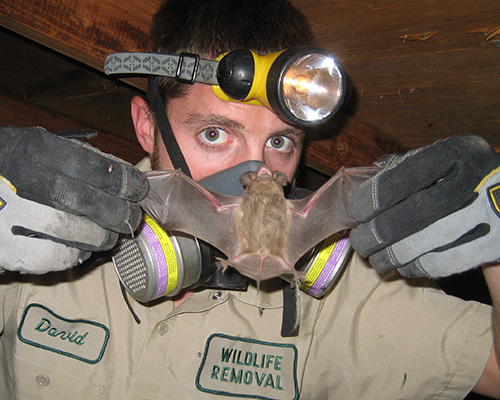
We are experts at removing bats from residential properties. Whether you have a single bat trapped in your house, a colony roosting in your attic, and/or various other problems, there is no need to worry! During our removal process, we make sure to inspect your entire home carefully, tracking down all the entrypoints bats are using to invade your place. Next, we perform a process called live exclusion (where no bats are harmed and all exit your property), then seal all entry holes completely shut. We also take care of the cleanup process after, so your home is safe and clean!
Learn MoreCommercial
Besides residential areas, we also have a wealth of experience removing bats from commercial properties! We begin by investigating the area for possible bat entrances, covering holes even as small as 1/4 of an inch. Through our live exclusion process, bats leave the building through one-way exits, and we seal up every hole afterward. Once the bats have been removed, we perform a cleanup process. This includes dealing with guano, replacing damaged insulation, and decontaminating the place.
Learn More
Contact us for bat removal today!
What Our Customers Say
I had a bat flying around in my house at 9pm, and CITY bat removal came right out and caught it in a net.
Sarah Lakewood
I had an annoying colony of bats stuck in my attic for a while before I finally decided to call for help. They were able to quickly and thoroughly solve the problem!
Brandon Chung
They did a great job clearing my attic of bats and didn't hurt any of the creatures.
Charlotte Demers
The technicians at CITY Bat Removal are skilled, professional, and know exactly what they're doing. Would highly recommend.
Mark O'Connor
My house stank of bats and their guano inside my wall. CITY Bat Removal not only removed the bats, they also got rid of the smell!
Alexis Ramirez
.jpg)
What Bats Are Endangered and Why
If you read anything about removing bats or develop a general interest in the species, you will likely notice that they are legally protected and some are endangered. This can lead to questions like which bats are endangered and why they are endangered.
Most of the species that are endangered are at risk for similar reasons. Those threats also affect non-endangered species of bats, putting them at risk of joining their cousins on the endangered species list.
Which Bats Are Endangered
There is some disagreement about which bat species are endangered. Some official estimates are much lower than others and this can come from a range of factors. Bias towards North American bat species in research is one issue. Lack of information or the inability to get accurate counts can be another.
Some of the bat species that are endangered include the following:
Fijian free-tailed bats
Florida bonneted bat
Hill's horseshoe bat
Jamaican Flower bat
Jamaican Greater funnel-eared bat
Why Bats Are Endangered – The Threats They Face
As mentioned, nearly all of the above endangered bats were put in their current position by a similar list of factors. The following are the most important reasons that some bats are endangered.
They Have Low Population Growth
One of the big reasons that many bats are endangered is that they have a very low population growth rate. Female bats typically only have a single pup (bat baby) each year. They also do not start reproducing until they are about two years old. At the very least, bats make up for this with long lifespans that are usually at least ten years and can be over 30.
This means that bats are equipped for slow and steady population growth, not quick growth. That makes them incredibly vulnerable to any reduction in their numbers, including from other threats on this list.
People Disturbing their Roosts
Unfortunately, humans bear a significant chunk of the blame for bats being endangered. This comes from the fact that we have invaded their space and, in the process, we have destroyed or taken over their roosts.
Bats that roost in trees have seen trees cut down to make way for cities or for wood. Bats that live in caves have had their caves disturbed for quarrying or mining. Others face intentional vandalism.
Although you may not realize it, even accidentally shining a bright light into a bat cave can reduce their chances of survival or cause them to abandon the roost.
Abandoned Roosts During Pregnancy or with Pups
When bats have to abandon their roosts, that action alone can kill some of them. The results are even worse if it is a maternity colony. If the bats are still pregnant and leave the roost, they will be forced to go into smaller groups. This will reduce the benefits of large maternity colonies, such as protection from predators and body heat.
If the pups are already born but not yet old enough to fly and their mothers have to leave the roost, the young will be left to die.
Humans Destroying their Habitats
In addition to the destruction of roosts, in particular, the fact that humans keep encroaching on and destroying bats' natural habitat puts them at risk. After all, when humans go into an area, we disrupt the entire ecosystem. Bats are likely to lose food sources and may starve.
Cats
Yet another human-related threat to bats that can cause them to be endangered is cats. In fact, cats are among the most common reasons that bats die. Any time that a cat catches a bat, that bat is likely to die.
You can reduce this effect by keeping your cat inside.
White-Nose Syndrome
White-nose syndrome is a disease that has led to reduced numbers of bats in many areas, especially in North America. Bats with this disease typically have white fungus by their noses, tails, ears, and/or wings. The fungus causes bats to wake up from hibernation. That, in turn, leads to them starving and losing body fat. White-nose syndrome may also cause dehydration.
Bats Are Legally Protected
All of the above reasons are the main reason that some cities and states have made bats legally protected species. Some species are also federally protected. Those protections mean that you cannot legally disturb maternity colonies or kill bats.